
Originally posted by Cronenberged
View Post
-
That's so much to digest...give me some time and I'll provide a detailed response. I very much appreciate the offer for the consult! I want to make sure I have my stuff straight beforehand.Originally posted by Suspension Decoder View Post
One quick question. Let's say I do get my car from 2590 lbs to 2475lbs and I can get the corner weights back to 50/50. Would I need to re-optimize the dampers? Springs? Or both? The pitch setup I had didn't seem terrible until I pulled a bunch of weight off the car.
I'm going back to 450lb front springs. Man, it was so good! I like being different. I love it when I tell people I have a gutted caged car with 450lb front springs. They tell me that it's too soft. Then I tell them the lap times I'm running...watch the jaw drop!
Leave a comment:
-
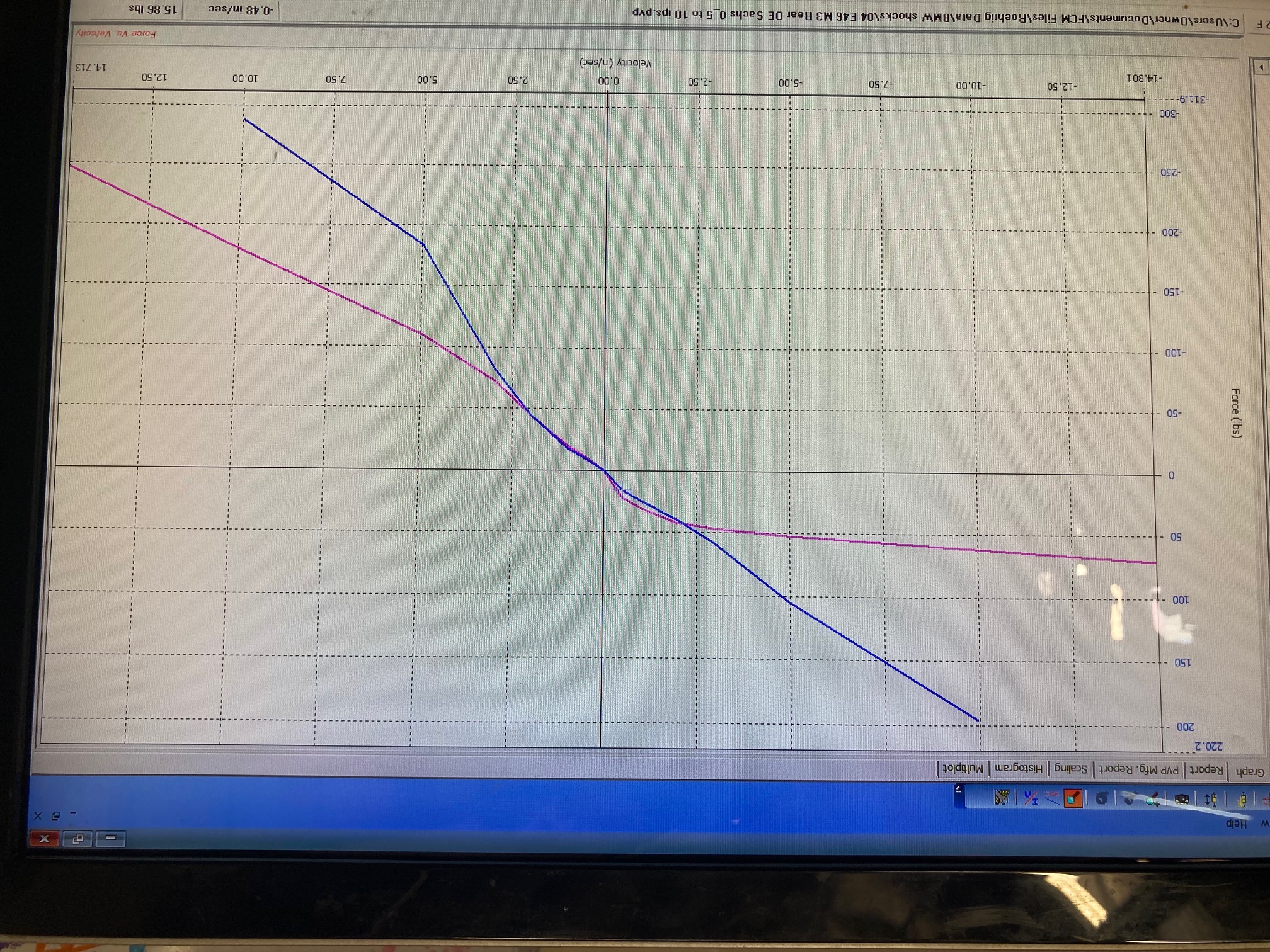
bigjae46 Back in 2017, I worked with a NASA ST4 E36 M3 racer, Percy. He got an FCM Elite Stage 3 setup for his car and was impressed at all the improvements over the TCK. While his may not necessarily be the same as your E46 TCK, they are likely very similar in design approach. The amount of NOISE his dampers produced, and the hysteresis, was about the worst I've ever seen / heard!


Note that his was an FCM Elite Stage 3 NOT the FCM Elite Stage 3 Ultimate which supercedes the Stage 3 and I developed in the 2020-2021 time frame. I'd say his results then are comparable to what my Stage 2 gives today as I began to focus even more on that 'tarmac rally' style approach. More bells and whistles on the Stage 3 Ultimate for a full damper velocity range tune (very low to very high), but any Stage gives you the necessary ingredients for a nicely-optimized suspension.
"So I had more mid-corner grip with your setup than I did with the TC Klines and that was very noticeable." - PercyLast edited by Suspension Decoder; 07-01-2024, 03:52 AM.Leave a comment:
-
Short answer: if I've done a build for that vehicle or already gathered all parameters I consider essential, then the process is very straight-forward. If I've never gathered the data or there isn't a known database of the values I need then I ask the customer to get those data or pay me to do it. I have flown or driven out to a customer site to analyze a vehicle per my methods, never had a car shipped out to me. Frankly, I'd rather take a road trip or flight (especially if to San Diego) than clean out my garage to fit a car here! Interacting with an owner is important to me and doing that in-person, when possible, is best.Originally posted by EthanolTurbo View Post
Medium-long answer: there are some key variables I need to account for in order to be comfortable re-engineering a factory suspension AND making changes to yield the maximum safe suspension travel and maximum usable grip via minimizing contact patch load variation. I have enough respect for factory Mech Engr's that I'd want to understand how the factory suspension was designed, what the current suspension has done differently than factory, and then what I need to change to get improvements inline with the owner's goals. So it's more than spec'ing dampers; if the goal is fastest lap times or maximum comfort then I have to be free to recommend new components if the current ones aren't up to muster.
FYI, I use this procedure I developed years ago as the starting point on gathering vital parameters. Then I usually ask for a stock front and rear damper assembly so I can measure the spring rate on y Longacre tester, the dampers on my Roehrig 2VS, and the bump stop on the latter as well. I also correlate the expected static load to the spring compressed height so I can estimate how much suspension travel is available before the factory bump stops engage. Every single OE suspension I've looked at engages the front bump stops almost immediately, usually combined with soft overall front compression damping and firm rebound. All of these parameters are quantitative ways to verify a driver's qualitative experience of things such as limit understeer, harsh ride, wallowing, etc. Often by someone's description of their cars behavior, I can guess pretty closely what their dampers will look like on the dyno.
also this playlist shows various steps in the procedure:
https://www.youtube.com/watch?v=yHr3yKcuESk&list=PLaHHNmjjz4mB9CpQ7aiks1U7 pUJWn0ham
===
For a vehicle I've already done these measurements on, a client only needs to fill out my FCM Elite consultation form and then engage with me for the consult call. I strongly recommend all new FCM customers get corner weights - even pure comfort customers.
If it's the first time and I don't have enough data or can't trust the data that's out there (e.g. a motion ratio without the supporting raw data to justify it), then someone has to gather those data. If my client is willing and able, they can do the characterization procedure on their own. I'm usually available in case there are questions during the process. Also, most competent (race-oriented?) shops can do the measurements if you show them what they need to do. A lift can be helpful but you'll need a transmission jack as well. Most of the time when I've done it, I've put the car on jack stands and used the floor jack to raise / lower the wheel to get suspension travel data.
The key sections are 2, 3, and 4. for suspension travel measurements then damper / spring motion ratio, and sway bar dimensions / motion ratio. I like to do bounce testing (section 1) when possible although some suspensions are so stiff (spring, damper, or both) you're just flexing body work or bouncing off the sidewalls. A big reason I like to do section 2 is to check the specific wheel & tire package at full compression and full steering lock to see where the points of potential interference are and also how much bump travel we might be able to safely free up via shorter bump stops, shorter damper bodies, or both.Last edited by Suspension Decoder; 06-30-2024, 10:36 PM.Leave a comment:
-
Question: do you only spec dampers remotely via data input or can someone ship you their car, send you the mod list and have you spec everything out based on seeing/driving the car in person?Originally posted by Suspension Decoder View PostLeave a comment:
-
Dropping a few links to videos that might be helpful:
Index:
1. Ryan Upham's E36 M3 experience with MCS 3-way prior to switching to FCM Elite (yes he got Stage 3)
2. How Shocks Work - Jacking Down (Rebound vs. Compression)
3. What is Flat Ride?
4. Why Flat Ride Matters (the MOST important video I've ever made)


 Last edited by Suspension Decoder; 06-30-2024, 09:44 PM.
Leave a comment:
-
bigjae46 Another comment on your ride frequencies, based on the corner weights and spring rates you provided. You have some mismatch in the side-to-side ride frequencies, looks like around 2.49 / 2.67 Hz front and 2.29 / 2.46 Hz rear. The LF and LR springs should be IMO 50 lb/in and 100 lb/in higher than the corresponding right. Also, I'm not sure if you're on stock sways due to NASA point limitations, but your setup does appear to be pitching right now but perhaps less than before? The damper behavior is likely affecting the overall real-world ride frequency compared to the undamped frequency, and there may be some bump stop contact happening as well. In fact, given the rebound-biased nature of the dampers I'm certain that's another factor to consider as a non-linear behavior you're fighting. I'm guessing that your current damper settings even with D/A are likely still giving a rebound bias though admittedly that's an informed ASSumption on my part.
My suggestion would be to separate the front and rear more, something like 425 / 375 front and 800 / 700 rear to get ~2.30 / 2.31 Hz front and 2.45 / 2.46 Hz rear. That'd be about 6% Flat Ride. To keep a similar FRC / handling balance you'd want a slightly bigger front bar, like an Eibach 27mm or just deal with the slightly looser handling with alignment / pressure / other adjustments.
If we were going to work together, I'd really want you to get a Ground Control front tubular Race and start with it on a softer setting. It's such a great piece with a HUGE adjustment range and you ought to get some weight off the nose of the car as well.
Then, as another change to address the low speed understeer, you'd likely want to reinstall the factory rear bar (or any small bar that fits). Without a rear bar, any car will experience terminal understeer in high steering angle (large weight jacking) maneuvers. This is due to an asymmetry in the roll center migration front vs. rear. The front bar being present limits the dynamic roll center change while on the rear with no bar, the droop is higher and the rear roll center changes more. This acts like a dynamic understeer effect which is what we experience particularly in slower turns with higher steering input / weight jacking. Kudos to Emilio at 949Racing who pointed this out. If you look for some posts by him or anyone else who understand the phenomenon, it makes sense and echoes my prior experience when I used to run Miatas with no rear bar and got terminal low speed understeer. I always recommend any racer run a rear bar - and a good quality adjustable end link to prevent bind & preload.
I think the current pitching behavior, the lack of rear bar, rebound bias in the TC Kline, and near-certainty of bump stop interaction and dynamic spring rate changes due to jacking down are all points to address to get further optimization from your tire contact patch. You can make a few changes even with your current TC Kline (and maybe run them even softer than you have them, I don't know what settings they're at currently) and likely get further improvements. But unless the TC Kline design allows you to bias the damper more toward 'rally-style' tuning, especially at high damper velocities, you WILL need a superior damper to get to the next level.
I really do think a good front tubular bar will be part of that package. There is something to be said for running as little overall bar as possible, but not when you're dealing with pitch and probably can't get on the power aggressively enough or if the car is still pitching / oscillating back-and-forth, your results are limited. I didn't ask about your LSD type and behavior which also plays a role.
It sounds like you've done great to this point - I'd like to see you get even faster. The FCM Elite Stage 2 will be a good choice and also show others on this forum that you don't have to sell a kidney to get an awesome Fat Cat setup.Attached FilesLast edited by Suspension Decoder; 06-30-2024, 08:07 PM.Leave a comment:
-
-
Hi bigjae46 - I remember when you posted some feedback on the old forum when you tried going from a pitch-based spring rate setup to Flat Ride. IIRC, you like it. Your comments here reflect that again and I'm glad to hear it!Originally posted by bigjae46 View Post
The TC Klines are weak in compression and strong in rebound as is the case with nearly every twin-tube I've come across, and quite a lot of monotubes as well. This results in a propensity to jack down and bottom out.
You don't NEED to go with the Stage 3 Ultimate - in fact, I'd almost rather you DIDN'T because it seems people get scared off by the $4400 price tag (I get it, it's a lot of money) and the Stage 2 @ $2400 gives you a LOT of value for the money. I still calculate max bump force to avoid launching the car up in the car, and I adjust max rebound force to avoid high speed jacking down.
To be very honest, by going to Flat Ride and making whatever bar / aero / alignments adjustments you need likely solved 70% of your overall problems. Your results reflect that improvement. One of the 'magical' things about Flat Ride with the higher rear wheel rate / ride frequency is that the your car WANTS to rotate through the turn (instead of the front dragging the rear when you have pitch).
Another magical thing with Flat Ride (my 'first principle of Ride Harmony') is that (shhhh) the dampers have to do much less work compared to a pitch-based setup! And if you get very clever, once you have Flat Ride if you have a clever shock builder you can do cool things like design anti-bottoming / internal bump stop behavior (sorta like a rally car but I keep saying that don't I...??). This really isn't possible when the front and rear are pitching and fighting each other. It's a miracle to get through the turn without sawing at the wheel like you're driving a damn gokart.
Mind you, if you had pitch, you'd have to run more rebound - that's what I had to do in the beginning when I was designing race setups. Everyone used higher front frequencies and that means a lot more rebound to control everything. If you don't force the front to be unnaturally higher frequencies than the rear then the car has a faster settling response via Flat Ride, and the dampers have to do a LOT less work. That also means better longevity, and it makes the dual-duty of street driving an FCM Elite much more pleasant. You only need to tweak tire pressures for the track and you're good to go.
So let's talk - and I think if you aimed for an FCM Elite Stage 2 you will find it exceptionally capable. You'll really be able to feel the difference that a superior damping approach can make.
I would invite anyone reading who doesn't know what I mean by Flat Ride to watch my 'What is Flat Ride and Why Should You Care' video. Then - most importantly - take the time to fully watch the 'Why Flat Ride Matters' video. Looking back, it is THE MOST IMPORTANT experiment I've ever done and has been the focal point that's guided my suspension design approach. The road test was in an Audi A4 Avant using Flat Ride but DEAD DAMPERS (I totally drained the dampers before the shop installed them for a bounce test). I wish I could communicate what a revelation it was to feel that car over a variety of surfaces, including through a slalom (empty industrial roads on Sunday are fun!). It still lives in my memory like my last crazy redhead girlfriend's perfume. Actually, that's faded a bit but I remember how the Avant felt.Last edited by Suspension Decoder; 06-30-2024, 07:25 PM.Leave a comment:
-
OPEN OFFER to the NA M3 forum:
As a thank you to Ian for giving me a place to share data and engage in a respectful way, I'll make this offer to bigjae and any other E46 M3 enthusiast. I'll offer a free 30 min free consult to any E46 M3 owner who wants to reach out to me and mentions having seen my offer on this site. I won't be helping plan all details of your build, but we can get into theory and practice, talk ride frequencies and so on. I want to answer any questions or points that may be unclear in terms of my approach to suspension optimization so YOU will be able to make a better buying decision. Not just for your M3, but for anything you decide to modify down the road.
If you do decide to do a build then we can do the 30 min paid consult at that time.
If for some reason I get 100 people asking for consults I might reduce it to 15 min free, but let's see how it goes. I tend to have 30+ min conversations anyway and I don't charge people for every minute past that. The main point of the consult fee was / is to weed out the time-wasters. I didn't mean it to scare people away from calling to ask questions but the law of unintended consequences applies 😅Last edited by Suspension Decoder; 06-30-2024, 08:09 PM.Leave a comment:
-
At this point it practically IS a guarantee to go faster when switching to FCM. People show up with TCK, Ohlins, MCS, JRZ, Moton, whatever and always go faster with an FCM Elite Bilstein-based setup.Originally posted by bigjae46 View Post
The challenge here is I really need to think about what I want before doing the consult with FCM. I think I’ll know more after the consult.
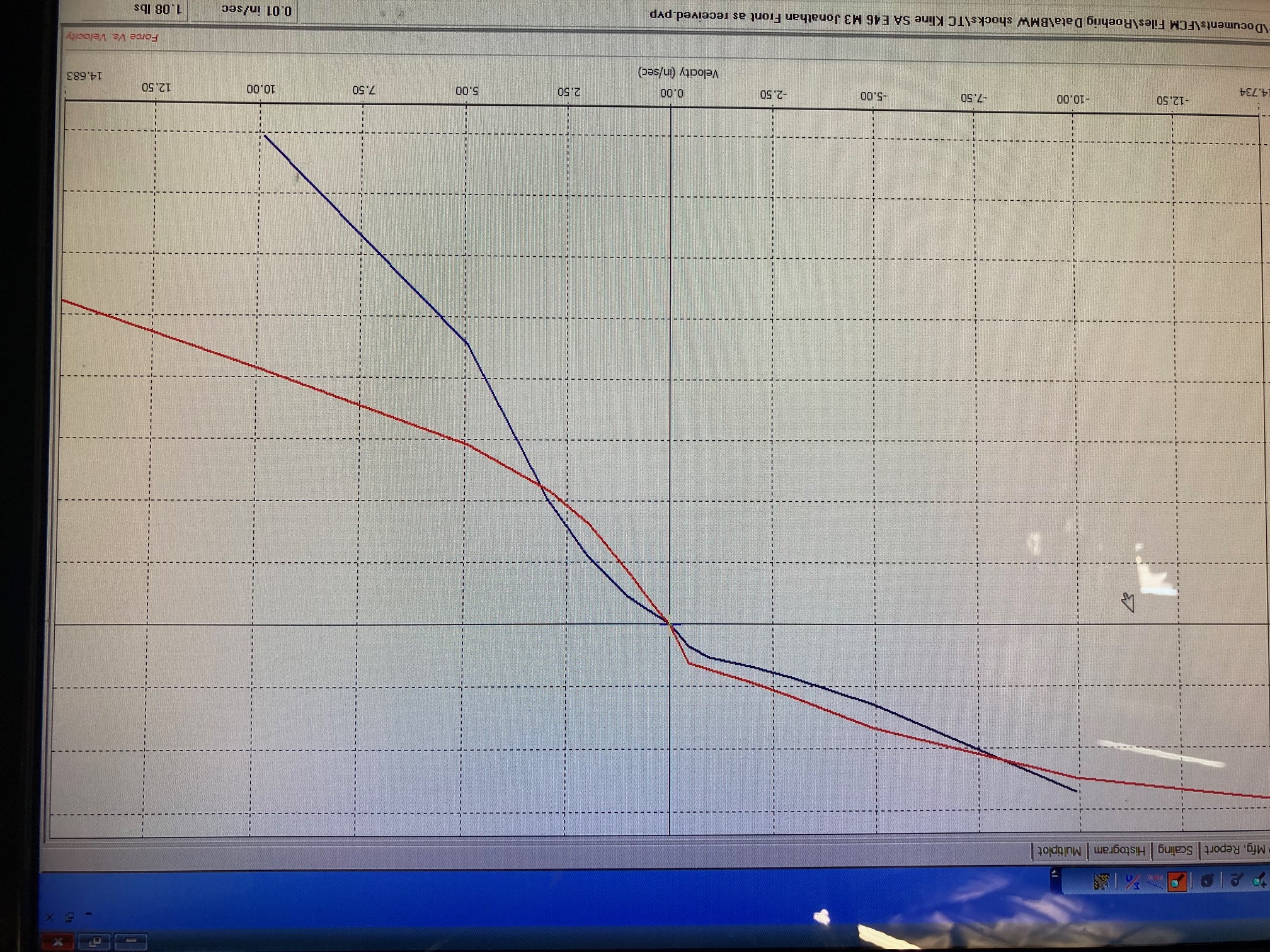
The TC Kline front and rear have a fair amount of low speed jerk in bump which isn't good for tire grip or lap times (or comfort - amazing how those three are connected...!).
The TC Kline front rebound is less aggressive than OE which is better for overall grip and compliance but it still has a linear-esque curve and IMO too much HS rebound. Also too little HS compression.
The TC Kline rear bump is VERY soft while the rebound builds fairly linear it seems (up to 10 ips at least). You get into jacking down by 3 in/sec and the rear is constantly going to be pulling you into the bump stops. Not good.
The twin-tube design shows a decent amount of hysteresis - it simply can't be as consistent as a well-tuned monotube, esp. in hotter driving conditions.
Most people don't know what to ask a vendor to change - I sure didn't at the beginning of my suspension adventures. There are certain behaviors a damper can produce which - no matter the setting - will result in worse lap times and/or comfort (again, they're more connected than you may realize).
Think 'tarmac rally style' suspension tuning more than 'NASCAR style' (rebound-biased). Almost everything out there is the latter, while the superior and provably faster approach is the former (which is how I tune).Last edited by Suspension Decoder; 06-30-2024, 08:09 PM.Leave a comment:
-
Lol…The goal is sub 2500lbs - about 2475 so I can install a cage with .095 wall tubing which should cut another 60lbs. Would be awesome if I could get to 2400lbs but that will be really tricky.Originally posted by mrgizmo04 View Post
I have done almost all of the deleting and removal - just the secondary oil cooler remains. Need to figure that out. I’m at the point where I need to spend money and make things in a lighter material.
I don’t see a way to get to my goal without making the weight distribution a little worse. So one question I will have for FCM is how much of an impact will 1%-2% change in distribution have on how the dampers will be built before re-corner balancing?
or…what is the cost to re-optimize? I don’t mind spending the $5k up front and a little more as needed with car changes. Don’t want to spend $5k and another $5k. Rather just rebuild the TCKs for now and go FCM when the car is at the target weight.
If it weren’t African hot here in TX…I could make some good progress.Leave a comment:
-
It's $1200 as far as I know, $300/corner.Originally posted by bigjae46 View PostLeave a comment:
-
Lack of adjustability is a positive or a negative depending on your point of view. The upside is that you can’t screw it up. The downside is that if you change your spring rates or meaningfully change the weight of your car, you do need to get the revalved.Originally posted by duracellttu View Post
I kind of love the freedom of no adjustability. So much less to be screwing with at track events—just worrying about camber and tire pressures is remarkably freeing.
Not sure I agree you’re getting the same thing with other high end dampers. FCM has a pretty different philosophy than any other suspension tuner I know of (minimize rebound, minimize shock pressure, flat ride). If that’s what you want, he’s a bit the only game in town.
Rebuilds of FCM modified shocks can be done by any Bilstein rebuilder. Valve changing… yes, you’re stuck with them. Would be problematic if they went away. That said… TC Kline looks to be WAY closer to retirement than Shaikh.
Leave a comment:


Leave a comment: