
Originally posted by maupineda
View Post
Originally posted by sapote
View Post
I was going to post this earlier but decided against it, however now that the thread appears to be going in circles because of these two random videos...
I agree with maupineda here. Driving the Vanos certainly takes some oil volume as well as pressure that is "lost" to the system. The Vanos pump cannot supply enough oil volume to continuously supply the Vanos solenoids. Luckily, the design of the system allows the camshafts to stay in their commanded position with little to no additonal input from the solenoids once that position is reached. Therefore only an initial supply of oil volume is required to move the cams to the commanded position, partially draining the accumulator, but then giving the pump a chance to replenish the reserve supply (similar to an Accusump for your oil system).
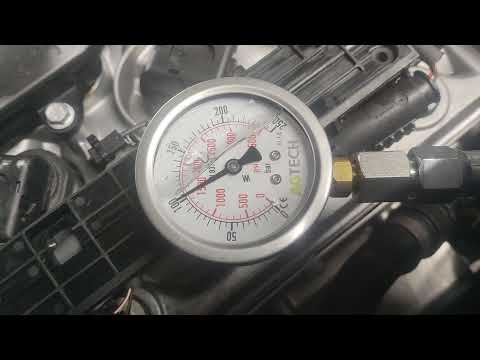
Unfortunately these two videos mentioned here are completely useless to compare. The video in post #1 shows pressure at idle, and then the engine is *very* lightly revved to 2000 RPM or so. In this situation the intake cam is likely not moved at all, and the exhaust cam only partially (look at factory DME Vanos target tables in these low-load sites). The 2nd video shows aggressive throttle stabs straight off idle. In this case, both cams are moved significantly, requiring much more oil volume, so of course the Vanos system pressure will drop much more.
Bottom line is, test your system pressure at a hot idle/free rev to determine if supply to Vanos pump or the regulator setting is the issue. If pressure seems to be regulated to a value below spec, adjust regulator. Then, test Vanos system. If system response and leak tests pass, you're fine. The Vanos system test (for the most part) puts MUCH more stress or load on the system than one would experience during normal, or even track, driving. During the test, the cams are driven from full rest to full advance (or retard in exhaust's case) at a relatively low RPM. This is something that almost never happens in actual driving, as the cams are constantly moved across only intermediate values at partial load.
The request for the cam to be driven from one mechanical stop to the other immediately will only ever happen if you suddenly go from 0% to 100% throttle below ~3000 RPM, and in that situation, cam response will be <300 ms (<0.3 seconds). If you do this low RPM stab over and over, AND you have a bad accumulator or weak Vanos pump, you MAY notice some slight reduction in engine torque response due to slower Vanos movement. Otherwise, it's your tune, or it's in your head.
Another way to put it (with data): it takes about 60-80ms to move your foot from 0-100% throttle during an aggressive stab, an additional 100-140ms for the DBW throttle system to open throttle from 0-100% on these cars. That's a total latency of ~150-220ms from when your foot starts to move to when the throttles are fully open, during which the Vanos is already moving to targets. If you have a "lazy" Vanos system that tests at ~300ms, then you're looking at roughly 1/10 of a second between when you reach 100% torque target and you actually get full torque with cams in final position. Additionally, in such a situation, the throttles provide about 75% of full torque, with the Vanos being in correct position accounting for the additioinal ~25%. Even a very astute driver would be hard pressed to notice this 100ms delay from 75 to 100% torque. Trust me, I'm unfortunatlely also all for spending money on things that don't really need fixing (lol), I just don't want a ton of people losing sleep over some issue they're experiencing and go down the Vanos rabbit hole when they don't need to.

Leave a comment: