Announcement

Collapse
No announcement yet.

Suspension woes and terrible noises - totally lost

Collapse
X
 
  • Filter
  • Time
  • Show
Clear All
new posts

    Suspension woes and terrible noises - totally lost

    Hey everyone. I'm a pretty decent DIY-er and I'm totally stumped. For months now, I've been dealing with what looks like variable on-center toe. It feels the harder I push the car or the warmer the day is, the more likely this symptom appears. I took my car to get aligned a couple time by my shop of 10 years in about September after replacing CA, CAB, steering coupler and inner outer tie rods. Still recognizing these issues, I began taking my car to a performance shop. I took it once and it was more or less just as bad. I took it back, stating this variable on-center effect and they added a ton more toe in, which I feel is simply masking the issue.

    Over the past couple months, a new clunking has been increasingly easier to hear. So last week, I put the car up and checked nearly everything. I pulled out the torque wrench on CA to knuckle, tie rod to knuckle, FCAB to chassis. I verified tightness on both rack mounts and the inner CA to subframe mounts. I also was going to loosen and tighten the strut clamp bolt, but they were insanely tight and they looked properly seated.

    After that day, a clunk as been increasingly more common. To better isolate, I removed the sway bar in entirety, hoping it would go away because the end links looked a little shot. While that didn't happen, the noise is way more subdued and seems to be more prominent when FL goes over road oscillations.

    Seeing this, I went to investigate, but I'm admittedly running out of new parts. So it's easy to now look at the strut/shock assembly (AST 5100 + Turner street camber/caster plates). I remove the strut bar and notice the top bolts can move freely with the car on the ground. I'll admit a little ignorance - I don't fully understand how this camber caster plate works, but I'll tell you this: it seems I can move the top mounting plate completely freely on the passenger side, but can't on the driver side. You can see this movement in this video: https://youtu.be/GFySq1A7ppw.
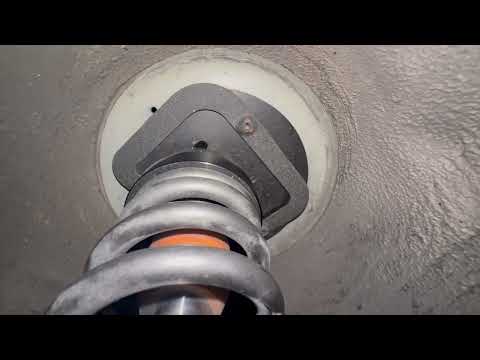


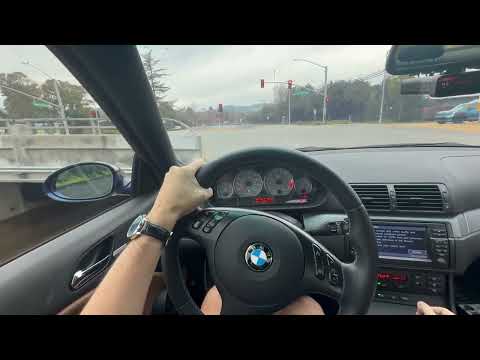
    The driving noises is 0-20 seconds, and you can see the movement from the top and bottom at 20-45 seconds, and the mild squeak I can create by grabbing the wheel to put a y-axis load on the wheel. In the video at 45 seconds, you can see that there's this odd amount of play you can get with very little physical effort. I'm also a man with a problem in the hunt of a problem, so I can't tell if this is confirmation bias. But when I look at this NAM3 link about the camber caster plates, I still can't discern how it mounts to the strut and understand there should be some movement allowed, but I don't think this much with weight on the corner should be permitted

    I'm a bit of a loss. I can't just keep throwing this thing at shops who just want to toe this thing in. Looking for suggestions on what to investigate, or confirmation that a camber/caster plate shouldn't be able to move like that. Like perhaps the bearing is blown, I don't know . But if the top can move, that would definitely explain my variable toe. Or if the bearing inside is blown, could explain my noise. Just running out of things to investigate, and the noise is very weird and doesn't sound metal on metal.

    It's very hard to capture irregular toe characteristics, but the car will tend to pull to the left under braking and pull to the right under cruise and acceleration. You can see the car basically want to steer into a ditch under normal braking, and then in the next clip, you can kind of see the turning right countersteer under braking.
    Last edited by YoitsTmac; 03-14-2026, 12:42 PM.

    #2
    Umm you should not be able to move the passenger side camber plate like that. Why is that not tightened?!Torque that down and report back.
    2005 BMW M3 ZCP Black/Black - HTE Tuning | Kassel CSL DME | 280/272 Schrick Cams+P54 Followers | Dinan TBs | Bosch 550cc | Radium Fuel System | Karbonious CSL Airbox+OE Snorkel | SS V1 Stepped+Catted Sec 1+Resonated Twin Pipe+Race | 3.91, 3 stage clutch | FCM 336/600 | Vorshlag Camber Plates, RSM | Rogue ASP | AKG FCABs, SFBs | TMS Front Sway, Camber Arms, Monoball RTABs, Pullies | Mason Race Strut + X-Brace | AS 30% SSK | SPAL | Redish Plates | VAC Exhaust Hub | WPC Rod Bearings

    Comment


      #3
      Originally posted by duracellttu View Post
      Umm you should not be able to move the passenger side camber plate like that. Why is that not tightened?!Torque that down and report back.
      I second this. You should not be able to adjust the camber with the front end on the ground.
      Old, not obsolete.

      Comment


        #4
        Sorry. I should have clarified. It's loosened the bolts because I was removing the strut bar to isolate the noise. The other side, driver, fully unbolted, was unable move up and down. So I didn't know if that represented top hat failure.

        It was torqued appropriately before driving again

        Comment


          #5
          Which FCABs are installed?

          Comment


            #6
            Originally posted by YoitsTmac View Post
            Sorry. I should have clarified. It's loosened the bolts because I was removing the strut bar to isolate the noise. The other side, driver, fully unbolted, was unable move up and down. So I didn't know if that represented top hat failure.

            It was torqued appropriately before driving again
            Running the same camber plates as you and mine behave the same. Studs on the passenger side move around freely when the nuts are loosened, but the studs on the driver side stick and require some persuasion from a mallet to scooch over. The studs are designed to be able to move independently from the plates so that you can achieve more camber than stock.

            Leading theory is that the driver side camber plate is slightly twisted in relation to the strut tower holes and that causes the studs to bind a bit. I haven't actually made any effort to confirm if this is the case or not since the car aligns up just fine.

            Regardless, the only way I think this behavior could cause your issue is if the studs are binding so much that you can't achieve the required clamping force between the camber plate and the chassis.

            Running any wheel spacers? Wheel bearings in good shape?
            2002 Topasblau M3 - Coupe - 6MT - Karbonius CSL Airbox - MSS54HP Conversion - SSV1 - HJS - Mullet Tune - MK60 Swap - ZCP Rack - Nogaros - AutoSolutions - 996 Brembos - Slon - CMP - VinceBar - Koni - Eibach - BlueBus - Journal

            2012 Alpinweiss 128i - Coupe - 6AT - Slicktop - Manual Seats - Daily - Journal

            Comment


              #7
              Not sure if the springs are loose at full droop but check that the bearing in the camber plate moves. Those turner plates use a piece of shit sealed roller bearing which is not at all sealed. Same with the ground control street camber plates. The bearing uses a plastic race while allows the bearing to get contaminated and then can seize or just fail. I had a GC plate on my E90 M3 and had to service the camber plate annually or it would start clunking.

              When you tap the brakes the front end dives. The spring is compressed and the camber plates should allow independent rotation of the spring. That is the only thing I can think of that would turn the steering wheel like that.

              Get a Vorshlag camber plate. 80k miles, 2 cars, and 14 years....not serviced once and still working great.

              Stay away from the roller bearings.

              Comment


                #8
                What are your camber and toe settings at all four corners, what front tire offsets, what brakes/pads and what rear trailing arm bushings are you running? And other than ASTs and camber plates, what other front things are not factory parts?

                Under what conditions does the clunk occur? It’s sort of unclear.
                ‘02 332iT / 6 | ‘70 Jaguar XJ6 electric conversion

                Comment


                  #9

                  Originally posted by heinzboehmer View Post

                  Running the same camber plates as you and mine behave the same. Studs on the passenger side move around freely when the nuts are loosened, but the studs on the driver side stick and require some persuasion from a mallet to scooch over. The studs are designed to be able to move independently from the plates so that you can achieve more camber than stock.

                  Leading theory is that the driver side camber plate is slightly twisted in relation to the strut tower holes and that causes the studs to bind a bit. I haven't actually made any effort to confirm if this is the case or not since the car aligns up just fine.

                  Regardless, the only way I think this behavior could cause your issue is if the studs are binding so much that you can't achieve the required clamping force between the camber plate and the chassis.

                  Running any wheel spacers? Wheel bearings in good shape?
                  I potentially suspected that the driver was just seized a bit. But again, I was basically looking for confirmation bias on the passenger after I was able to isolate it to one side.​ Wheel bearings show no signs of issues and no wheel spacers

                  Originally posted by bigjae46 View Post
                  Not sure if the springs are loose at full droop but check that the bearing in the camber plate moves. Those turner plates use a piece of shit sealed roller bearing which is not at all sealed. Same with the ground control street camber plates. The bearing uses a plastic race while allows the bearing to get contaminated and then can seize or just fail. I had a GC plate on my E90 M3 and had to service the camber plate annually or it would start clunking.

                  When you tap the brakes the front end dives. The spring is compressed and the camber plates should allow independent rotation of the spring. That is the only thing I can think of that would turn the steering wheel like that.

                  Get a Vorshlag camber plate. 80k miles, 2 cars, and 14 years....not serviced once and still working great.

                  Stay away from the roller bearings.
                  The springs could be spun at full drop with some resistance. There is a helper spring and I suspect this was by design. I started to look more closely at the bearing and it's my top suspect.


                  Originally posted by Bry5on View Post
                  What are your camber and toe settings at all four corners, what front tire offsets, what brakes/pads and what rear trailing arm bushings are you running? And other than ASTs and camber plates, what other front things are not factory parts?

                  Under what conditions does the clunk occur? It’s sort of unclear.
                  Stock camber toe in the rear IE in stock specifications. I have ran 0 toe for most of my E46 ownership years. After my local alignment shop changed hands, my next alignment felt really unstable. I have been referring to it as variable toe. It was as if at any moment, driving straight could be 15 degrees in either direction, predominately dictated by the road. On flat roads, it seemed acceleration pulled it one way, and deceleration pulled it another way. Correlation doesn't necessarily mean causation, but I think I would have had more confidence with my neighbor doing my alignment then my local shop's new alignment tech, who told me if I gave it 0 toe, it wouldn't drive straight. So then I went to a performance shop to do my alginment and told them do what you feel is best." They gave me like 0.1 toe in, alongsite -2.4 camber and ~8˚ of caster. The issue persisted, so they took it back and unfortunately dialed in more toe in. I told them this was almost certainly just better masking the issue at the expense of tire wear, but they said they didn't see anything stick out in the suspension.

                  So then I took it to another local performance shop that didn't drive it, but then asked if I knew old cars didn't have as direct and precise steering as modern cars. Always dislike when I come in speaking from a level of intelligence and they just assume I know fun buzz words.

                  I made this thread when things went from bad to worse. The variable steering turned into this clunk, and it has rapidly gotten louder. The warmer it is outside, and the more road oscillations I'd drive on, the more prominent the noise would be. The video above is without a sway bar installed (how I was able to isolate to one side). You can feel it in the chassis as if something is moving. When I removed the sway bar, I checked the torque of every other bolt with no irregularities. the duratino of the noise would pick up with speed, so I ruled out wheel bearings (along with the complete absense of any road howl).

                  Solution was found:

                  Feeling like I was at a dead-end, there was really only one more potential culprit: the strut assembly. Admittedly, a bit impulsively, I bought myself a nice new suspension, but it's 5 weeks out. The car is clearly no bueno and every time I drove it, I felt it was going to fail in some catstrophic way. So to at least bring validation to my theory and to make sure the car felt self to move around.

                  I bought some used E46 struts. Just some garbage worn crap. I put it in, pulled the coilovers out, and went for a drive. Most reassuringly, the clunk noise is gone and the car no longer falls apart. Additional bonus, the car is absolutely hilarous to drive. With the front stock soft (140lb?) and the rear with a 560lb spring, the car is comedic. In a driveway, you don't feel the front even go over any oscillation and then the rear goes over. Under acceleration, the entire car bucks up. For me, this is the best ending. And yes, I understand this setup is completely unsafe to be pushed on. It's just to keep the car mobile, no backroad driving. It's just to hold off until the new stuff comes in. Then alignment, new front tires and the car will be ready for some well overdue fun drives.

                  Comment


                    #10
                    Stock suspension for the win! Wouldn’t blame you for going back

                    …says the guy who removed aftermarket stuff for stock M3 springs
                    ‘02 332iT / 6 | ‘70 Jaguar XJ6 electric conversion

                    Comment

                    Working...
                    X